Ports are often seen as logistics infrastructure. In practice, they are much more. They influence where industries locate, how supply chains are structured, and how regions, populations, and economies develop over time.
This relationship between ports and industry is not incidental. It is shaped by cost, scale, and access. It is often described as port-led industrialisation: the development of industrial activity driven by proximity to ports and other transport infrastructure.
From Movement of Cargo to Location of Industry
At its core, port-led industrialisation is driven by one factor: the cost of moving goods.
Ports can reduce transport costs for both inputs and outputs. This has a direct impact on industrial location decisions.
- Bulk industries such as steel, cement, and power depend on large volumes of raw materials. Locating near a port can reduce inbound logistics costs.
- Import-dependent industries benefit from proximity to shipping routes, reducing lead times and inventory requirements.
- Export-oriented manufacturing gains from faster access to global markets and more predictable logistics.
Over time, these cost advantages influence where industries choose to establish operations.
Beyond simply handling cargo, ports influence where economic activity becomes viable.
The Mechanics of Industrial Clustering
Industrial clustering around ports is not random. It happens because of a set of reinforcing mechanisms.
First, the presence of a port reduces logistics costs for factories and other producers.
Second, supporting infrastructure develops to serve these industries.
Third, additional industries locate nearby to benefit from shared infrastructure and supply chains.
This creates a virtuous circle:
- Shared logistics reduces costs per unit
- Proximity enables faster movement of intermediate goods
- Service providers and ancillary industries emerge
- More industries identify benefits from co-locating
As the ecosystem grows, it becomes increasingly competitive, making it more difficult for new locations to compete.
Industrial clustering is not planned in isolation. It emerges from cost advantages that compound over time.

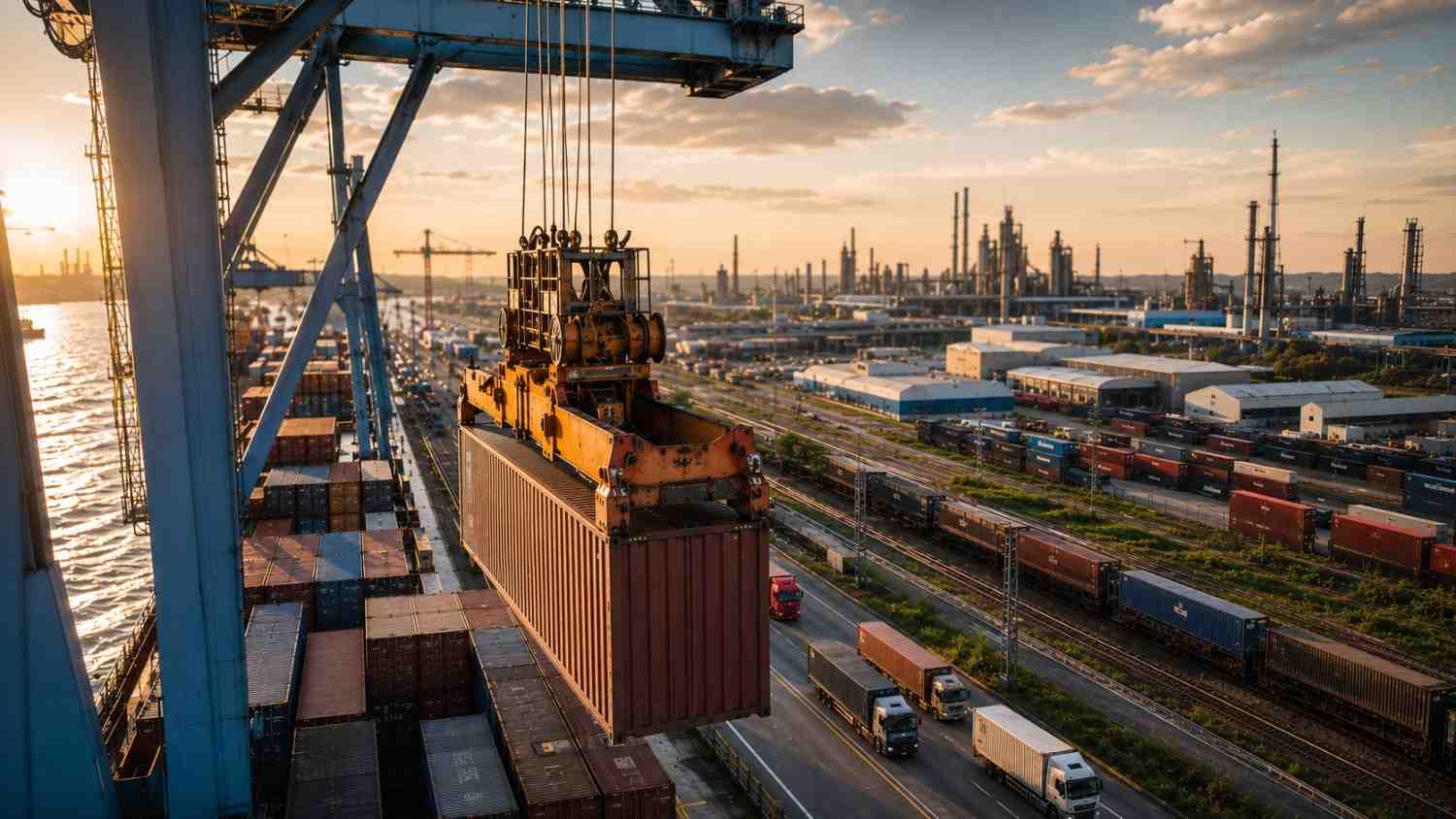
How Industrial Clusters Form Around Ports
Scale, Throughput, and Competitiveness
Not all ports attract industrial development. Location, access to raw materials, scale, and efficiency also play a role.
Ports that can handle large volumes efficiently offer:
- Lower per-unit transport costs
- Faster turnaround times
- Greater reliability in supply chains.
These factors directly affect industrial competitiveness.
For example:
- More frequent vessel calls provide more reliable access to market
- Access to different shipping lines provides competition within the logistics market
- Larger vessels reduce freight costs per tonne
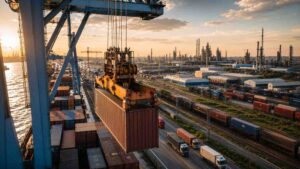
- Mechanised handling reduces loading and unloading times
- Efficient evacuation systems reduce delays beyond the port
When these elements align, the port becomes a competitive advantage for industry, not just a logistics node.
Efficiency at the port translates directly into competitiveness for industry.

Reinforcing Cycle Between Ports and Industry
Land, Infrastructure, and Policy Alignment
Industrial development around ports also depends on factors beyond the port itself.
- Availability of land for industrial use
- Supporting infrastructure such as power, water, and utilities
- A supportive regulatory and policy environment
Proximity to a port alone is not sufficient to deliver economic benefits, as policy, regulatory, manpower costs, raw materials, and infrastructure, all need to align.
This is where planned development becomes important. Ports that are integrated with industrial zones and logistics infrastructure are more likely to support sustained industrial activity.
The Indian Context
In India, port-led industrialisation has been explicitly recognised as part of the country’s infrastructure strategy.
The Sagarmala Programme includes the development of Coastal Economic Zones (CEZs) (planned industrial regions linked to ports to promote manufacturing and export activity), port-linked industrial clusters, and supporting logistics infrastructure.
The intent is clear: align ports with industrial growth rather than treating them as standalone assets.
In practice, outcomes have varied.
Locations such as Mundra Port demonstrate how port infrastructure, connectivity, and industrial development can evolve together. Deep draft facilities, mechanised terminals, and strong rail and road connectivity have supported the growth of logistics and industrial clusters in the region.
Other ports, including Jawaharlal Nehru Port, have focused more on container traffic and capacity expansion, with industrial development occurring more diffusely across the hinterland rather than in the immediate vicinity of the port.
At the same time, several planned industrial zones have progressed more slowly than expected due to land acquisition challenges, connectivity gaps, and coordination issues.
This variation highlights a key point:
Port-led industrialisation requires alignment across infrastructure, policy, and market demand. It does not emerge automatically.
Integration with Logistics Networks
Industrial development around ports is closely linked to logistics integration, as explored in our previous blog.
Efficient connectivity allows industries to:
- Source raw materials from multiple locations
- Distribute finished goods to domestic and export markets
- Operate at larger scales with lower inventory costs
Without this integration, industries face higher logistics costs and reduced competitiveness, even if they are located near a port.
Ports enable industrial development only when they are embedded within an efficient logistics network.
Beyond Proximity: Reliability and Predictability
For industry, cost is only one part of the equation. Reliability matters just as much.
- Predictable turnaround times
- Consistent cargo handling performance
- Efficient documentation and clearance processes.
These factors determine whether supply chains can operate smoothly.
Ports that offer consistent performance become preferred nodes for industry. Those that do not may struggle to attract sustained investment, regardless of their physical capacity.
Port-led industrialisation is not a separate outcome. It is a continuation of how ports function within a broader economic system.
When ports are integrated with logistics networks, supported by infrastructure, and aligned with industrial demand, they become anchors for economic activity. When these conditions are not met, their impact remains limited.
🔗 What follows
The next piece examines how ports are financed and operated, and how different ownership and operating influence investment, risk, and performance.