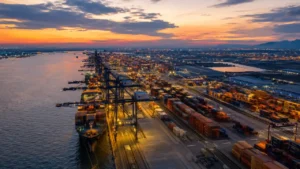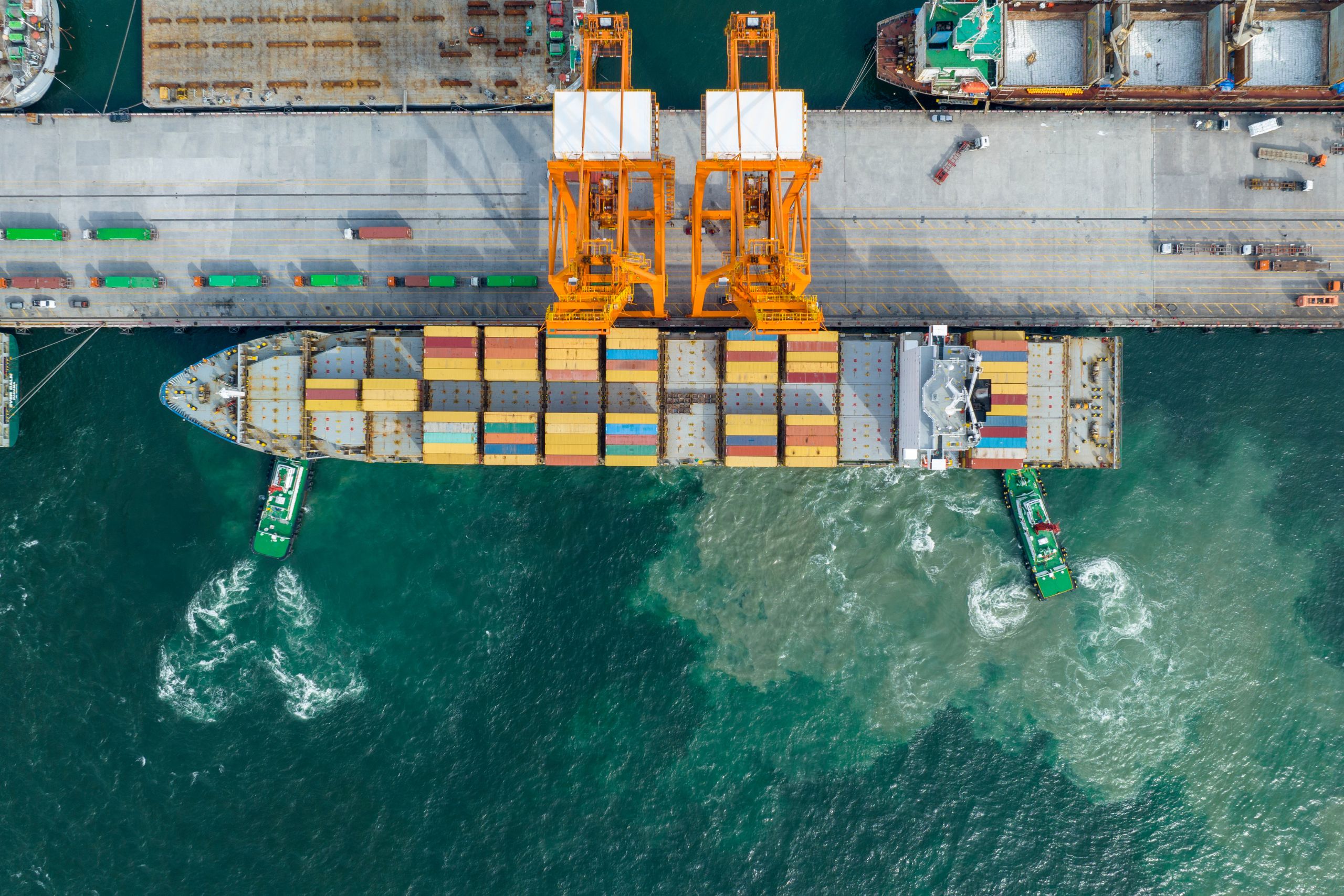
Ports are engineered into the coastline. What appears as a fixed piece of infrastructure is the result of multiple layers of planning, design and construction, each responding to the physical constraints imposed by the sea, weather, people, and economics.
While the final form looks simple, the development process behind it is sequential with iterative cycles of planning which evolve the final form. Each interaction stage builds on the previous one, and early decisions have a major influence on both cost and long-term performance.
Understanding the Site
Every port begins with a basic question: does this location offer a long-term solution to the problem we are trying to solve?
Answering this requires a combination of surveys and analysis. Engineers study seabed depth, soil conditions, wave patterns, and sediment movement to understand how the site behaves over time. These inputs determine whether the site is naturally favourable or will require significant interventions to create and maintain suitability.
A location with natural depth reduces dredging requirements assuming protection is required to provide calm water for the ships to load and unload. Conversely, high wave exposure or active sediment movement increases both construction complexity and maintenance needs. Strong layers of ground at the right level minimise the cost of foundations, significant depths of soft ground provide settlement and foundation problems. Stiff ground can increase the cost of shaping the land and/or dredging for access.
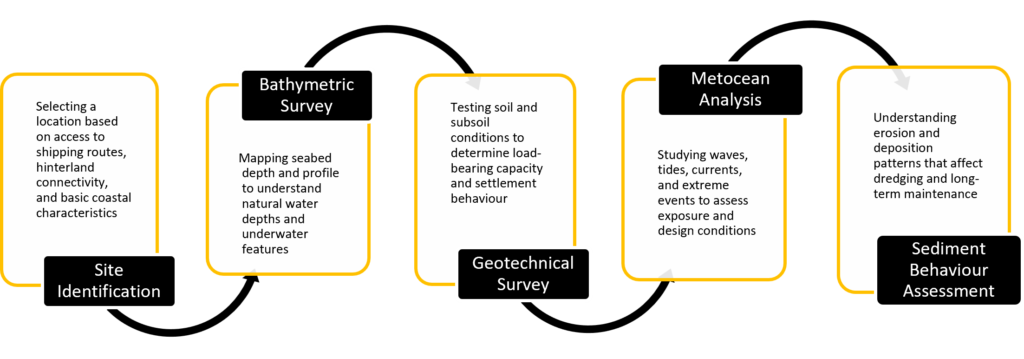
At this stage, a series of investigations are carried out, each serving a specific purpose. These investigations collectively shape the layout and design of the port.
Early-stage site conditions determine not just how a port is built, but how it performs over its lifecycle.
This process typically follows a structured sequence:
Creating a Controlled Marine Environment
Ports need sufficient calm water to enable cargo handling that is not interrupted by sea and weather conditions too often. How calm the water needs to be depended on the cargo. Pumping oil from tankers can be done in higher waves than lifting containers. All ships require the right sea conditions to berth safely, and sometimes this is achieved by constructing breakwaters that reduce wave energy and create a sheltered port area.
The design of these structures depends on wave height, direction, and frequency. To ensure the port can be maintained these structures must not interrupt sediment flow and cause maintenance dredging. In exposed locations, breakwaters (structures built offshore to reduce wave energy and create calm water conditions) can extend several kilometres and often represent one of the most capital-intensive elements of the project.
Once protection is established, the operational edge of the port must then be created. Mooring buoys, offshore jetties, alongside berths and quay walls (buoys, jetties and dolphins, vertical retaining structures) all of which can enable different types of cargo to be loaded and/or unloaded) are designed to accommodate vessel loads, berthing and mooring forces, and cargo handling equipment.
Creating calm water conditions is fundamental to port operations, and drives the scale, cost, and configuration of marine structures.
The sequence of development typically follows:

This stage defines the physical interface between ship and shore.
Creating Depth and Land
Natural conditions rarely align with operational requirements. The activities within a port must therefore be shaped to meet specific depth and land needs.
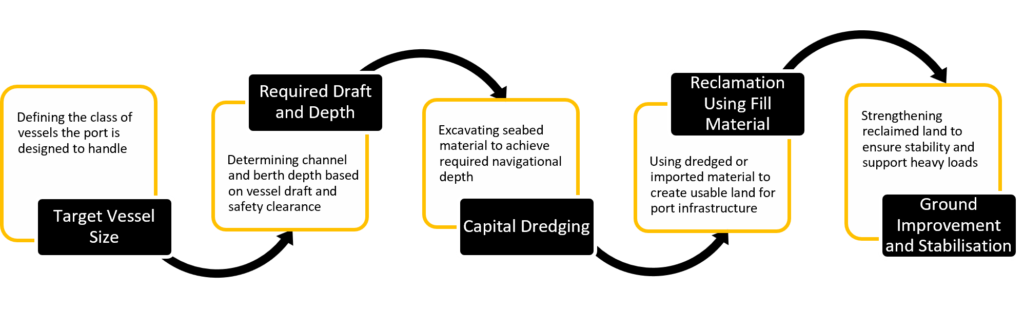
Dredging is used to create navigable channels and berth pockets. The extent of dredging depends on the size of vessels the port is designed to handle. Larger vessels require deeper drafts to move and turn; this increases both capital dredging (initial excavation to create required depth for vessels) volumes and ongoing maintenance dredging (periodic removal of accumulated sediment to retain that depth) requirements.
At the same time, land is created through reclamation (creation of usable land by filling shallow coastal areas). This involves placing fill material to form usable areas for terminals, followed by ground improvement to ensure stability. Without this step, the reclaimed land may continue to settle for decades, affecting storage areas and how equipment can operate.
The relationship between these activities follows a clear sequence:
This phase transforms the site from a natural coastline into a usable platform.
Designing for Cargo and Operations
Once the physical platform is established, the port is configured for its primary function: handling cargo efficiently.
The design varies significantly depending on cargo type. Container terminals require structured yard layouts, high-capacity cranes, and optimised circulation. Bulk terminals depend on conveyor systems and stockyards, while liquid terminals integrate pipelines and tank farms.
The focus shifts from structural design to operational efficiency. Layout decisions influence turnaround time, congestion, and throughput (the volume of cargo a terminal can handle over a given period).
Terminal design is driven by cargo type and volume, with each decision influencing layout, equipment, and overall operational efficiency.
This transition from infrastructure to operations follows a clear logic:

Sequencing and Phasing Construction
Port construction is not a linear process. Multiple activities are planned and executed in parallel, with sequencing driven by both engineering constraints and practical considerations.
Breakwaters are often constructed early to create safe working conditions. Dredging and reclamation may proceed simultaneously. Berths and terminals are typically developed in phases to align with demand and manage capital investment.
Marine construction introduces additional complexity. Work is dependent on weather windows, equipment availability, and site accessibility. These factors make scheduling more dynamic than in typical land-based infrastructure projects.
Port construction is phased and interdependent, with marine works typically preceding landside development to create safe working conditions and stable platforms.
A simplified sequence looks like this:

In practice, several of these activities overlap, with sequencing driven by site conditions, weather windows, and project phasing.
Engineering in the Indian Context
In India, port construction is a combination of new development and expansion of existing infrastructure.
Greenfield projects such as Vizhinjam International Seaport involve building the entire system from the ground up, often in open sea conditions. These projects require extensive breakwater systems, deep dredging, and longer development timelines.
Brownfield expansion in India’s major ports presents a different challenge. At ports such as Jawaharlal Nehru Port, new infrastructure must be integrated within an operational environment. Construction must be phased to minimise disruption, and design must account for existing constraints.
Ports such as Mundra Port illustrate a third approach, where capacity is added incrementally over time through additional berths, deeper drafts, and increased mechanisation. Though we should not forget Mundra port was a greenfield project less than 30 years ago.
Across all models, timelines are influenced not only by engineering but also by environmental approvals, logistics, and marine working conditions.
Port construction is a process of controlled transformation. It converts a dynamic natural environment into a stable, high-capacity logistics interface.
The visible infrastructure is only a part of this system. Much of the engineering lies below the surface, in how the seabed is shaped, how the ground is stabilised, and how each layer is sequenced.
The quality of these decisions determines how efficiently a port will operate, not just at commissioning, but over decades.