Key Takeaways
- The Landlord Port Model has emerged as the preferred commercial framework for modern ports worldwide.
- Public-Private Partnerships (PPPs) enable governments to leverage private capital while retaining ownership of strategic maritime assets.
- Well-defined risk allocation enshrined in clear enforceable legal agreements is fundamental to attracting investors and ensuring long-term project success.
- India’s port sector has adopted the landlord model with implementation evolving through the Major Port Authorities Act, 2021, revised Model Concession Agreement (MCA) 2021, and the strategic roadmap outlined in Maritime India Vision 2030 and Maritime Amrit Kaal Vision 2047.
Introduction
Ports are no longer viewed merely as gateways for international trade. As global supply chains become increasingly sophisticated, ports must make significant investments in infrastructure, cargo handling systems, hinterland connectivity, digital technologies, and sustainability initiatives.
Historically, governments financed, owned, and operated port infrastructure as public utilities. The growing scale and complexity of maritime infrastructure have encouraged a gradual shift towards commercially sustainable business models that combine public ownership with private investment and operational expertise.
Today, financing structures and business models are as important to a port’s success as engineering design. A commercially robust framework not only attracts investment but also improves efficiency, enhances service quality, and ensures long-term financial sustainability.
Understanding Port Business Models
A port’s business model determines who owns the infrastructure, who finances developments, who operates terminals, and how revenues and risks are distributed.
Among the various governance structures adopted globally, two models dominate policy discussions.
Service Port vs. Landlord Port
Parameter | Service Port Model | Landlord Port Model |
Land and Infrastructure Ownership | Public Authority | Public Authority |
Terminal Facilities Investment | Public | Private Operator |
Cargo Handling Operations | Public Authority | Concessioner |
Revenue Streams | Operational Income | Lease rental, Concession fees, Revenue share |
Operational Flexibility | Moderate | High |
Global Adoption | Reducing | Increasing |
Under the Service Port Model, the port authority owns, finances, and operates every aspect of the port. While this provides complete governmental control, it places considerable financial and operational responsibility on the public sector.
The Landlord Port Model, by contrast, separates ownership from operations. The port authority retains ownership of strategic assets such as land, breakwaters, navigational channels, and common infrastructure, while private concessionaires invest in terminal equipment and operational facilities under long-term lease or concession agreements.
The Landlord Port Model has become the international benchmark because it combines effectively public oversight with private sector efficiency, innovation, and investment.
Public-Private Partnerships: Powering Port Development
Modern ports require investments running into billions of dollars, making Public-Private Partnerships (PPPs) an essential mechanism for infrastructure development. Rather than privatising ports, PPPs allocate specific responsibilities to private developers while governments retain ownership of strategic assets. It is the usual method through which the Landlord Port Model is implemented.
The most common PPP structures include:
PPP Model | Key Features | Common Application |
Build-Operate-Transfer (BOT) | Private operator builds, operates, and transfers the asset at the end of the concession period | Container and break operations |
Design-Build-Finance-Operate-Transfer (DBFOT) | Private sector designs, finances, constructs and operates the facility before transfer | Major greenfield developments |
Concession Agreements | Long-term contract defining investment obligations, revenue sharing, performance standards and asset transfer | Most modern terminal developments |
Typical PPP Lifecycle
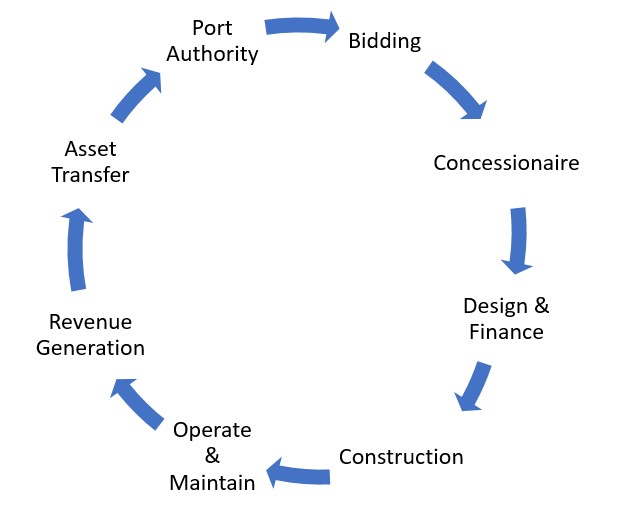
In India, PPP projects at major ports are implemented through competitive bidding under the Model Concession Agreement (MCA) 2021, this was introduced to provide greater contractual clarity on investment obligations, performance standards, dispute resolution, and risk allocation.
Risk Allocation: The Cornerstone of Successful PPPs
One of the defining characteristics of successful PPP projects is that risks are allocated to the party best positioned to manage them. Balanced risk allocation improves project bankability, reduces financing costs, and enhances investor confidence.
Typical Risk Allocation Matrix
Risk | Primary Responsibility | Rationale |
Construction | Concessionaire | Controls engineering and EPC execution |
Traffic | Concessionaire | Revenue depends on cargo throughput |
Regulatory | Government | Ensures policy and legal stability |
Environmental Compliance | Shared | Shared responsibility for approvals and operational compliance |
Force Majeure | Shared | Governed through provisions in the concession agreement |
Rather than transferring every risk to the private sector, modern concession agreements seek to distribute risks fairly, ensuring that projects remain commercially viable throughout the concession period.
Revenue Streams Drive Commercial Viability
Unlike many infrastructure assets ports often have diversified revenue streams that can be seen as strengthening long-term financial sustainability. This benefit comes with a problem, it also means the commercial risk taken by the private sector can be hard to quantify for all parties.
Primary Revenue Sources
- Marine charges (pilotage, berth hire, towage and vessel-related services)
- Cargo handling charges
- Storage yards and warehousing
- Container Freight Stations (CFS)
- Land leasing and concession fees
- Logistics parks and multimodal facilities
- Rail connectivity and inland logistics
- Ship repair, bunkering and other value-added services
The Landlord Port Model enhances commercial resilience for the Landlord by enabling port authorities to generate stable, recurring income through long-term leases thus enabling them to raise relatively low-cost debt. The private operators, often with substantial numbers of other terminals, optimise terminal productivity and customer satisfaction.
💡 Did You Know?
Maritime India Vision 2030 envisages investments exceeding ₹3 lakh crore across India’s maritime sector to enhance port capacity, logistics efficiency, coastal shipping, and multimodal connectivity.
India Focus: Evolution of Port Commercialisation
India’s port sector has undergone a significant transformation over the past three decades.
Initially, major ports operated predominantly under government-managed Service Port structures. However, an inability to raise finance and increasing trade volumes and infrastructure requirements encouraged greater private participation through PPP-based terminal development.
This evolving ecosystem has enabled both major and state ports to attract private investment while expanding national cargo handling capacity.
Evolution of India’s Concession Framework
India’s concession framework has matured alongside its maritime sector.
- Early Concession Models (1990s–2000s): Early agreements often featured rigid tariff structures dictated by the Tariff Authority for Major Ports (TAMP). This led to disputes over revenue sharing and limited commercial flexibility for private terminal operators.
- Model Concession Agreement (MCA) Standardization: The introduction of standardized MCAs brought clearer risk-sharing norms, structured dispute resolution mechanisms, and transparent bidding processes based on royalty revenue-share per unit of cargo.
- Modern Reforms (Major Port Authorities Act & Tariff Flexibility): Recent policy shifts, including the Major Port Authorities Act, 2021 and revised PPP guidelines, have granted major ports greater autonomy, abolished rigid TAMP tariff caps, allowed market-linked pricing, and introduced flexible transfer and restructuring options for legacy PPP berths.
These reforms have strengthened investor confidence by introducing greater transparency, balanced risk allocation, standardised concession terms, and improved governance mechanisms.
Expert Insight
The future competitiveness of ports will depend not only on deeper channels and larger terminals, but also on the strength of their commercial structure. Investors increasingly seek predictable regulation, transparent concession agreements, and balanced risk-sharing mechanisms that support long-term returns.
For India, continued refinement of PPP structures, commercially sustainable concession models, and integrated multimodal development will be central to achieving the ambitions outlined in Maritime India Vision 2030 and Maritime Amrit Kaal Vision 2047. As ports evolve into integrated logistics ecosystems, the ability to combine sound financing with efficient business models will remain a key differentiator in attracting investment and supporting sustainable maritime growth.
References
- Ministry of Ports, Shipping and Waterways, Government of India. Maritime India Vision 2030.
- Ministry of Ports, Shipping and Waterways, Government of India. Maritime Amrit Kaal Vision 2047.
- Major Port Authorities Act, 2021.
- Ministry of Ports, Shipping and Waterways. Model Concession Agreement (MCA) 2021 for PPP Projects at Major Ports.
- Ministry of Ports, Shipping and Waterways. Public-Private Partnership Framework.
- World Bank. Port Reform Toolkit (Fourth Edition).