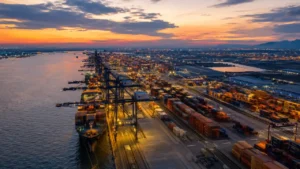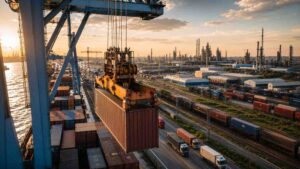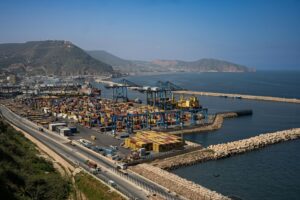
Ports are the interface between land and sea. They are designed to enable the controlled movement of cargo from ship to land transport. In doing so, they help shape trade routes, logistics systems, and patterns of industrial development.
At a system level, a port functions as a node within a network. Its relevance is determined less by its physical footprint and more by how effectively it connects maritime routes with production and consumption centres. This means ports are both infrastructure assets and economic enablers.
The development of a port begins well before any construction is visible on site. The selection of where to build is a strategic decision. Does the location suggest that cargo will choose to use the port? Is it a location where factories could make their products competitively? If there are prospects for cargo, natural depth, shoreline stability, wave conditions, and sediment movement determine whether a location can support long-term operations without excessive intervention. These parameters influence everything that follows, from capital cost, the need for maintenance dredging, downtime due to weather, tides, dry seasons and wet seasons and many other factors.
From these beginnings the development of the port can be seen as a layered system:
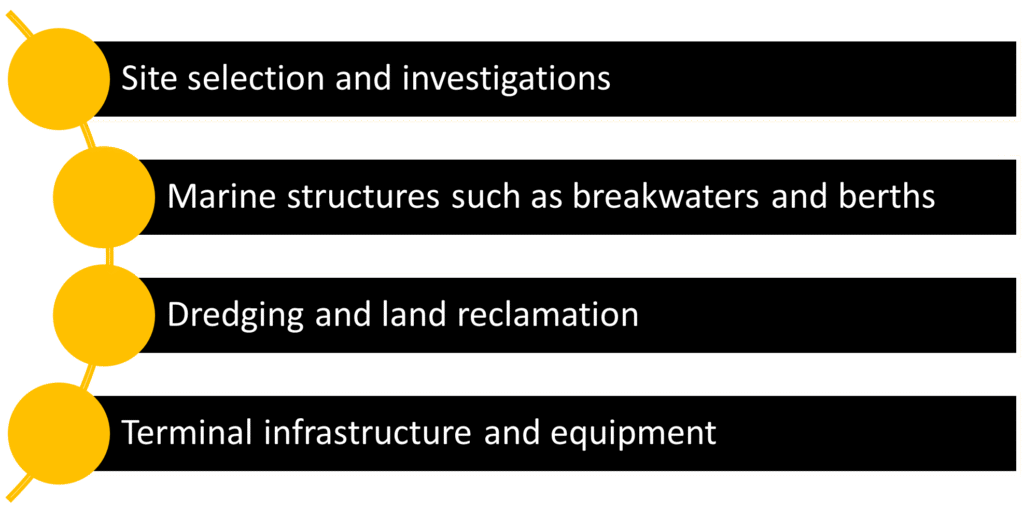
Each layer provides different interpretation of the physical characteristics of the selected site. Put together they define how the port will perform over time. Some of these aspects will be examined in more detail in the next part of this series.
Globally, ports that combine natural advantages with engineered capacity tend to anchor trade networks. They attract larger vessels, enable consolidation of cargo, and influence routing decisions. Others operate as feeder nodes within these systems.
In India, this positioning has had measurable implications. A significant share of container traffic has historically depended on transshipment at foreign ports. The development of deep draft gateway ports and transshipment infrastructure is intended to address this.
Projects such as the Vizhinjam International Seaport reflect this shift. Conceived as a deep-water transshipment hub, the project has been positioned to handle mainline vessels and reduce reliance on external hubs. The policy direction aligns with providing self reliance within India’s port infrastructure.
The same intent is visible in capacity expansion and modernisation at established gateways such as Jawaharlal Nehru Port and large-scale private developments such as Mundra Port. These offer deep draft, larger scale, draft, and faster vessel turnaround times.
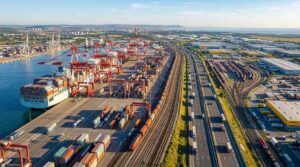
The port, however, is only part of the system. The landside interface determines how cargo flows through the system. Rail links, road access, and inland logistics infrastructure connect the port to its hinterland.
This relationship between port capacity and hinterland infrastructure remains one of the defining constraints in India. While throughput continues to grow, hinterland connections have not always scaled at the same pace. Major ports handled over 915 million tonnes of cargo in FY 2025 to 26, reflecting steady growth in volumes and operational improvements.
Policy has increasingly sought to address the need for hinterland infrastructure. The Sagarmala Programme emphasises port connectivity, coastal shipping, and logistics efficiency, supported by broader initiatives such as Bharatmala Pariyojana and PM Gati Shakti National Master Plan, which focus on strengthening road networks and integrating infrastructure across transport modes.
Ports influence where industries choose to locate. Bulk cargo industries tend to cluster near ports to reduce transport costs, while export-oriented manufacturing benefits from proximity to shipping routes. Over time, this leads to the formation of industrial ecosystems around major ports. This is visible in locations such as Mundra Port, where port operations, logistics infrastructure, and industrial activity have evolved together.
At the same time, ports such as Jawaharlal Nehru Port continue to expand capacity and improve efficiency through brownfield development and terminal upgrades.
The operational character of ports has also evolved. Mechanisation, containerisation, and digital systems have changed how cargo is handled and tracked. Turnaround time is now a core performance metric, with several ports reporting sustained improvements.
This evolution is shaped by:
- Automation and equipment modernisation for ship-to-shore cranes, automated stacking cranes, conveyorized bulk handling systems, and gate automation
- Digital platforms and port community systems for documentation, electronic data interchange, and integrated stakeholder coordination
- Data-driven planning and coordination through real-time cargo tracking, vessel scheduling systems, and yard optimisation tools
Adoption of these improvements across Indian ports remains uneven. Private ports have generally moved faster in mechanisation and technology integration, while some major ports continue to operate with hybrid systems.
Environmental considerations and risk are integral to port development. Ports alter coastal systems and remain exposed to them over their lifecycle. Coastal regulation, sedimentation patterns, and climate exposure influence both design and long-term operations.
These considerations are prominent in project planning, contributing to longer development timelines and increased complexity in approvals and execution.
Viewed together, ports are not standalone assets. They are constructed systems that combine policy, economics, logistics, marine engineering, geotechnical design, equipment selection, digitalisation, and other requirements. Their performance depends on how well these elements function as a whole.
In India, the direction of the sector is increasingly clear. Capacity creation has progressed significantly. The next phase is defined by integration, improving connectivity, reducing logistics costs, and aligning ports with industrial and freight systems.
Sources:
- Government of India (PIB, Ministry of Ports, Shipping and Waterways)
- Indian Ports Association
- Standard port engineering and planning references (PIANC, UNCTAD, World Bank)