Ports are often advertised by their capacity, water depth, or infrastructure quality. In practice, their value is determined just as much by what lies beyond the port boundary.
A port does not operate in isolation. It is part of a larger logistics system that connects production centres, consumption markets, and trade routes. The efficiency of this system depends on how quickly and reliably cargo can move in and out of the port to each of these origins and destinations. Hinterland connectivity, the transport links that connect a port to inland production and consumption centres, is as critical as the port itself.
Beyond the Port Boundary
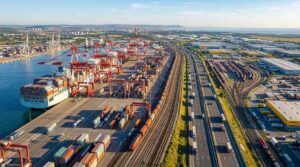
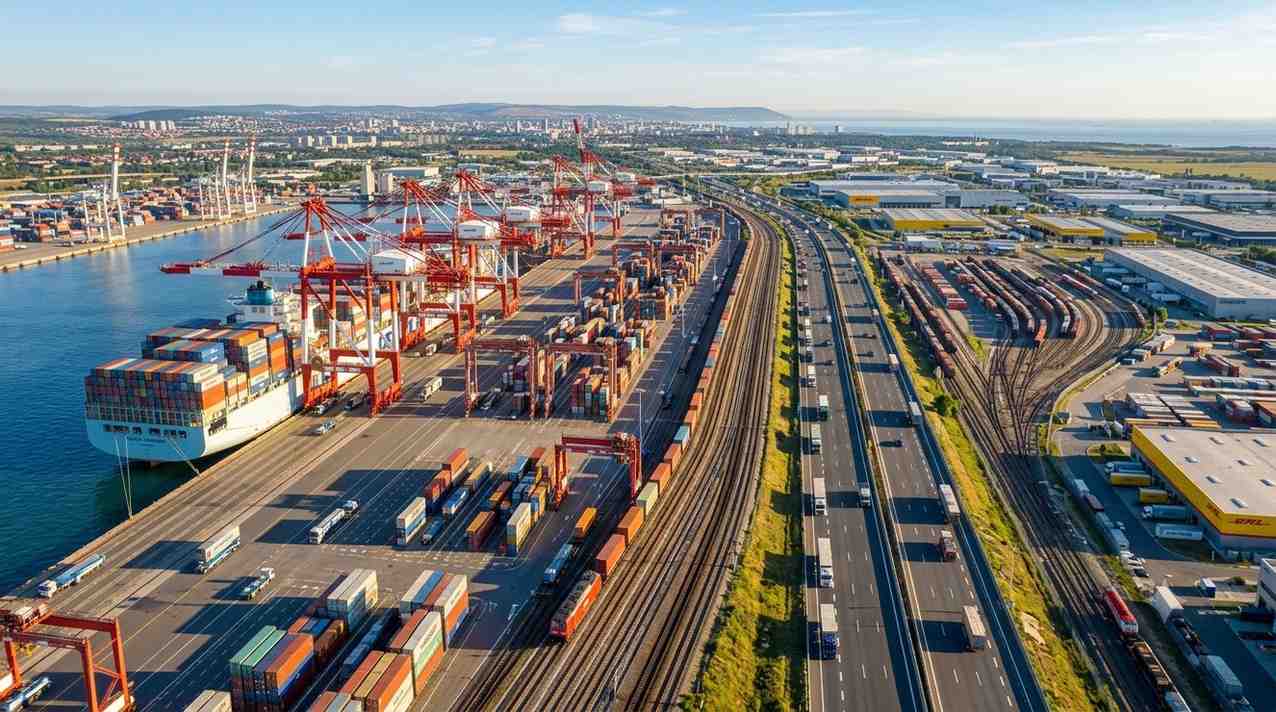
The movement of cargo does not end at the berth. Once discharged, it must move inland through the transport systems. Road haulage, railways and inlands waterways.
Roads handle a large share of short- to medium-distance cargo. Rail provides cost-efficient movement for bulk and long-distance freight. Inland waterways offer an alternative in specific corridors.
Each mode has a role, but their effectiveness depends on how well they and the port are integrated. A well-connected port enables continuous cargo flow. A poorly connected one becomes a point of accumulation (congestion).

From Port to Hinterland: Cargo Movement Chain
Port efficiency is not just defined on the quay side. It is defined across the whole network from origin to destination for each and every cargo it serves.
When Capacity Outpaces Connectivity
Port infrastructure is often expanded in response to growing demand. Additional berths increase handling capacity, larger vessels bring higher volumes, and mechanisation improves loading and unloading speeds.
However, these gains assume that cargo can move out of the port at a similar pace.
In many cases, this does not happen. Rail capacity may be limited, road access may be constrained, and last-mile connectivity may be inadequate. As a result, cargo is delayed within the port as it waits for its turn down the road to its final destination.
What looked like a highly efficient port is let down by the supporting systems as they constrain the benefits to the ships and shipping lines rather than delivering them to the full supply chain.
Capacity without evacuation does not improve efficiency. It defines the bottleneck.
The Last-Mile Constraint
The most critical constraints are often the least visible.
Even where major infrastructure exists, bottlenecks occur at the interface between the port and the network.
- Limited road access near port gates
- Shared rail corridors with passenger traffic
- Inefficient gate and truck movement systems
These constraints can be large in impact. A few kilometres of restricted access can offset the benefits of large-scale port infrastructure investment.

Where Bottlenecks Emerge in the Cargo Movement Chain
This is where many ports experience the greatest loss in efficiency.
Extending the Port Inland
To address these constraints, ports are increasingly being linked to inland infrastructure.
Inland Container Depots (ICDs; dry ports located inland that extend port services closer to cargo origin and destination points) extend port operations closer to cargo origin and destination points. Multimodal Logistics Parks (facilities that integrate road, rail, and storage infrastructure for cargo consolidation and distribution) enable consolidation and distribution across transport modes. Freight corridors provide dedicated, high-capacity routes for cargo movement.
This effectively redistributes the pressure on the port system. Instead of concentrating activity on the quayside, the size of the infrastructure is sized across the end-to-end network.
The port becomes part of a distribution pipeline rather than a single node in a network.
The Indian Context
In India, this balance between port capacity and hinterland access has been a persistent challenge.
Port infrastructure has expanded significantly over the past decade, but evacuation systems have not always kept pace. This has led to a pattern where some ports face congestion, while others operate below capacity due to limited connectivity.
Policy has increasingly identified the problem and changed to address the situation. The Sagarmala Programme continues to emphasise port connectivity and coastal logistics. At the same time, broader initiatives such as Bharatmala Pariyojana and PM Gati Shakti National Master Plan focus on strengthening road networks and integrating infrastructure across transport modes.
Dedicated Freight Corridors are expected to improve rail-based cargo movement, particularly for long-distance freight, reducing dependence on road transport.
The efforts have seen varying degrees of success. Some ports benefit from strong multimodal connectivity, while others continue to face constraints at the first and last mile.
Integration as the Next Phase
The focus of port development is evolving further.
Earlier phases prioritised capacity creation through new terminals, deeper drafts, and mechanisation. The current phase is defined by integration.
- Aligning port capacity with evacuation infrastructure
- Improving coordination across transport modes
- Reducing logistics costs and transit time
This represents a shift in how port performance is understood.
The effectiveness of a port is no longer defined by how much it can handle, but by how efficiently cargo can move through it.
Hinterland connectivity is not an extension of the port. It is part of the system that defines it.
Ports that are well connected function as efficient nodes within a logistics pipeline. Where port and hinterland access are not balanced operate below their potential, regardless of the quality of their infrastructure.
🔗 What follows
The next piece examines how ports influence industrial development, and how logistics infrastructure shapes the location and growth of economic activity.